
Wisconsin potato growers have increasingly reported concerns about the diseases
By Amanda Gevens, professor and Extension vegetable pathologist, University of Wisconsin (UW)-Madison Department of Plant Pathology
Wisconsin potato growers have increasingly reported concerns about black dot and silver scurf over the past several years. These diseases are often subtle during crop development, yet can significantly impact tuber appearance, storability, and marketability by harvest and throughout storage.
Unlike explosive diseases such as late blight, black dot and silver scurf tend to develop quietly and are heavily influenced by environmental stress, soil conditions, crop injury, and long-term production practices.
As weather patterns become more variable and production systems evolve, these diseases appear to be gaining importance across the industry.
Black dot is caused by the fungus Colletotrichum coccodes, and the accompany photo shows black dot tuber symptoms. The pathogen survives in soils and crop residue as structures called microsclerotia.
One of the challenges of black dot is that infection often occurs very early in the season but remains symptomless for weeks if not months.
Like other Colletotrichum pathogens, the fungus infects plants latently or mildly during early growth stages and later becomes more aggressive and symptomatic once the crop begins allocating energy into tuber production.
Black dot symptoms may include premature vine decline, lower stem discoloration, reduced root vigor, uneven crop maturity, and tuber blemishes. Black dot is frequently associated with the Potato Early Die.
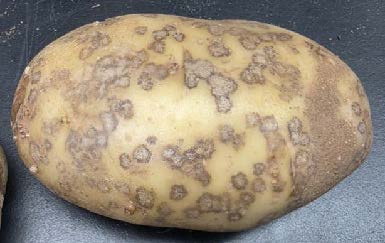
Silver scurf is caused by the debris and seedborne fungal pathogen Helminthosporium solani and primarily affects potato tuber skin, as per the accompanying photo.
The disease can be noted at time of harvest, but most often becomes more visible during storage and may appear as silvery or bronze discoloration, patchy skin blemishing, increased shrink and moisture loss, and reduced visual quality.
Silver scurf can continue developing during storage, particularly under humid conditions and extended storage periods.
Several factors may be contributing to the increasing occurrence of black dot and silver scurf across Wisconsin and other potato-producing regions.
Warmer winter soil temperatures may preserve infected crop debris and pathogen inoculum more effectively than in the past.
In addition, growers increasingly face intense rainfall events, rapid drying cycles, high winds, blowing sand (creates wound sites for earliest infections on newly emerged potato crops), hail, unexpected cold, and heat extremes during spring and fall “shoulder seasons.”
These weather fluctuations can physically damage plants and create favorable conditions for infection.
Reduced tillage systems in crops prior to the current year’s potato production may preserve infected residue longer and slow the decomposition of pathogen-infested material. For black dot particularly, infected crop debris can remain an important inoculum source.
Avoiding excessive undecomposed residue at planting, allowing adequate decomposition time, maintaining good hill drainage and aeration, and considering brassica cover crops where appropriate can help limit inoculum.
Even certified seed potatoes can harbor low or asymptomatic levels of these pathogens. Silver scurf, particularly, is strongly associated with seedborne inoculum and storage contamination.